
Our Program
for
Livelihoods and Entreprise
We help women turn the resources of their villages -Himalayan herbs, grains, and traditional crafts - into high-quality products that can be sold locally and beyond.
Through our seed distribution program, we also provide women with the agricultural resources to strengthen household food security, expand local cultivation, and create new opportunities for income generation.
Through practical training in regenerative agriculture, artisan crafts, food processing, packaging, and cooperative development, women build skills that strengthen economic self-sufficiency while preserving the cultural traditions of Himalayan village life.
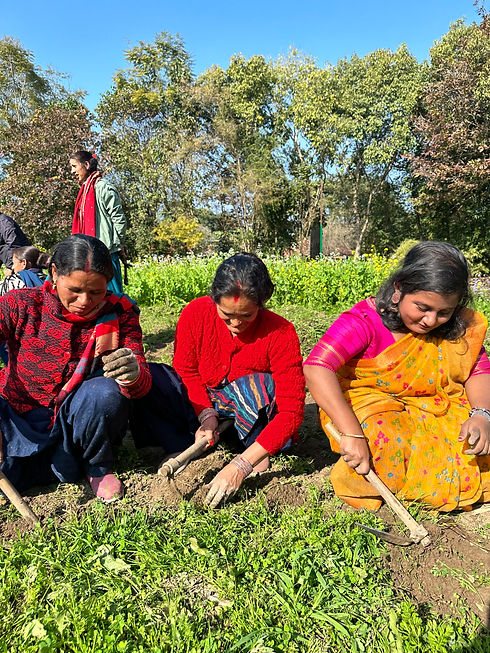
Regenerative Practices for Healthy Communities
Our programs also integrate sustainable practices rooted in ancient wisdom: regenerative agriculture, organic farming techniques, seed conservation, cultivation of medicinal herbs, and natural pest management. These methods protect the environment, restore soil health, and ensure long-term food security for their communities.

By blending traditional knowledge with modern market skills, we enable women to build micro-enterprises and strong SHGs - creating livelihoods that are both profitable and sustainable.
Our Program
includes
-
Product Development & Quality Control - Crafting goods that meet high standards while honoring local authenticity.
-
Packaging, Labeling & Branding - Creating attractive, informative packaging that helps products stand out.
-
Market Linkage & Pricing - Connecting with buyers, understanding demand, and setting fair prices.
-
Cooperative Finance & SHG Growth -Strengthening self-help groups and building financial resilience together.

Seed Distribution Pilot Program
The Himalayan Devis Project has launched a seed distribution pilot program supporting 3,000 women across Himalayan villages with the goal of strengthening household food security, nutritional self-sufficiency, and sustainable rural livelihoods.


Each participant receives a carefully planned seed package designed to support year-round household food production while also creating the potential for additional income generation through surplus crops and local distribution.
The pilot currently operates at an estimated cost of approximately ₹1,500–1,600 (USD $15) per participant.
Seed distribution is organized according to Uttarakhand’s three major seasonal planting cycles, allowing cultivation plans to align with local climate conditions, traditional agricultural rhythms, and optimal growing periods.


Kharif
(Monsoon Season)
Rain-fed crops and seasonal cultivation
Rabi
(Winter Season)
Cold-season crops and household food supply
Zaid
(Summer Season)
Vegetables, herbs, and short-duration crops

A Scalable Model
The crop varieties, planting strategies, and seasonal plans have been developed in consultation with leading agricultural universities and specialists in order to optimize soil health, crop diversity, nutritional value, and long-term sustainability.
This initiative is intended to serve as a scalable pilot model for future expansion across the wider Himalayan Devis network, supporting greater food security, economic resilience, regenerative agriculture practices, and community self-sufficiency throughout Himalayan villages.